Panda Works Club
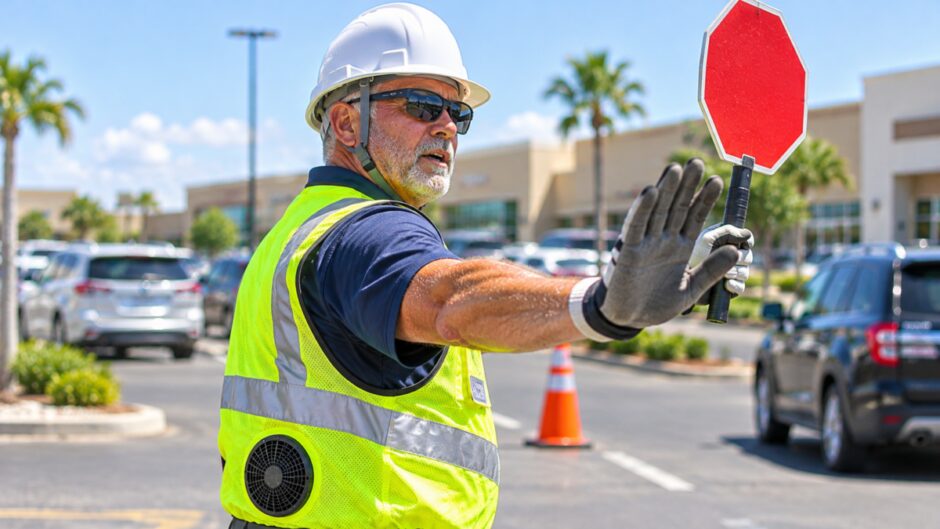

Stand on a stretch of asphalt directing traffic for a full shift and you’re dealing with two things at once: direct sun with nowhere to step out of it, and pavement that can run 40–60°F hotter than the air temperature on a sunny day. Summer 2026 was already the hottest on record in the US, and that radiant heat off the road surface is on top of whatever the thermometer says.
Traffic control and security work also comes with a constraint that construction and farm work mostly don’t: you often need to be seen, not just comfortable. This guide covers what to check before buying a cooling vest for this kind of work, including the one spec most listings quietly skip, and four options available on Amazon right now.
Where Fan Cooling Vests Come From: A Japanese Invention
This entire product category has a specific origin, not a vague “ancient technique” story. In the 1990s, Hiroshi Ichigaya, a former Sony engineer, tried circulating water through a prototype garment to cool himself on a hot business trip; the tank kept leaking. He switched approaches: small fans that pull in outside air and speed up the evaporation of sweat. He patented the design and brought it to market in 2004 under the name kuchofuku (空調服), literally “air-conditioned clothing.”
The mechanism is the same one doing the work in every vest compared in this guide: fans near the waist draw in ambient air, and evaporating sweat does the cooling. It isn’t a refrigerant, and the vest itself isn’t lowering the air temperature.
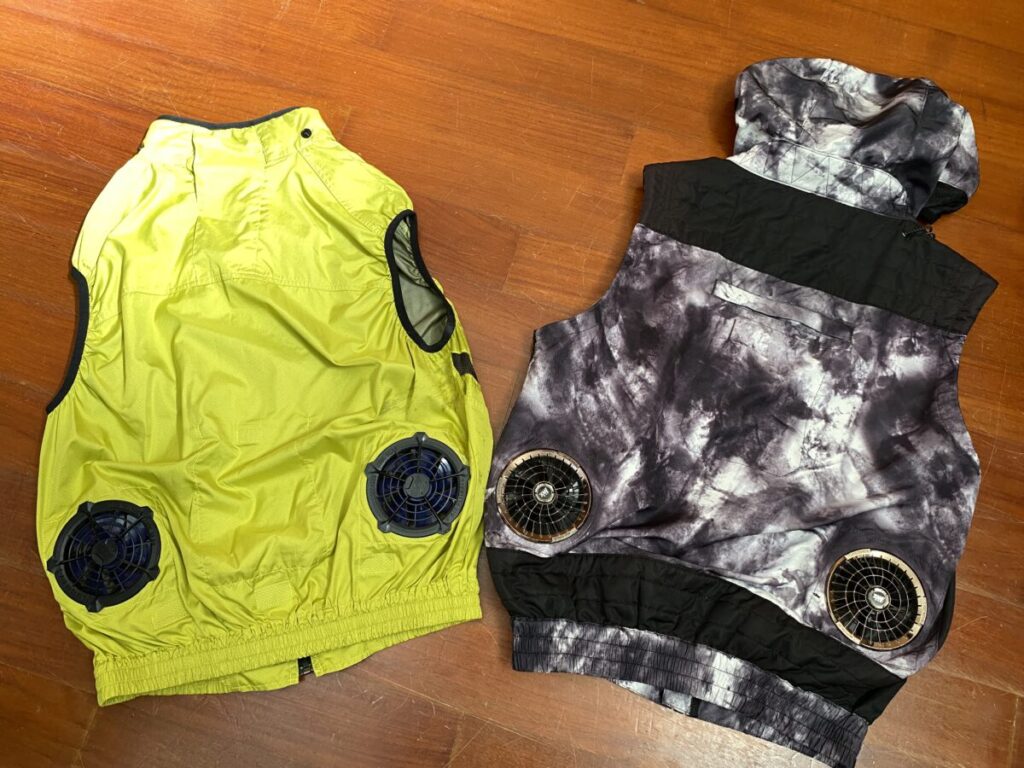
The category didn’t stay a niche product. A 2011 AFP report, amid a nationwide push to cut power use after the Fukushima disaster, put the number of Japanese companies issuing Kuchofuku’s gear to staff at nearly 1,000, including automakers, steelmakers, food manufacturers, and construction firms. It’s kept growing since: Japanese trade press (Sen-i News) estimated the domestic electric-fan-workwear market at roughly ¥20 billion in 2024, with newer entrants like Burtle now reported to hold close to half of shipment value, alongside the original Kuchofuku brand and Sun-S’s competing “kuchofuku-fujinfuku” line.
None of the vests compared below are official Kuchofuku products. They’re independent brands sold on Amazon, but they’re built on the same fan-and-evaporation design this Japanese invention started.
Sources: Government of Japan, “Cooling the Body with Fan-Equipped Clothes”; Web Japan, “Air-Conditioned Clothes”; AFP, “Air-conditioned clothes help Japan beat heat” (2011); Sen-i News market reporting (2024–2025).
Why This Job Is a Different Case
Crossing guards and flaggers are about as outdoor-exposed as a job gets: 97.6% of workers in the category report routine outdoor exposure. But the best-documented hazard for this occupation is being struck by a vehicle, not heat illness, and there’s no clean, dedicated count of heat-related deaths for flaggers the way there is for construction. Security work has its own mismatch: for security guards as a whole, assault is the leading cause of death, not heat. The heat risk in this guide applies specifically to guards posted outdoors (gates, lots, perimeters, event sites), not the profession generally.
What both jobs share, when the work is outdoors, is standing rather than moving. A construction worker or field hand generates some of their own airflow just by working; someone posted at a fixed point for hours doesn’t get that benefit, which makes active cooling gear arguably more useful here than in jobs with more natural movement.
The Spec Most Listings Skip: Certified Visibility
A lot of cooling vests are sold in yellow or orange with reflective tape and marketed as “safety” or “hi-vis.” That’s a color description, not a certification. Traffic control work in the public right-of-way is commonly required to meet ANSI/ISEA 107 high-visibility standards (Class 2 or 3 depending on the work), and a vest that merely looks like safety gear isn’t the same as one independently tested to that standard. If your job requires certified hi-vis apparel, check for an explicit ANSI/ISEA 107 claim, ideally one backed by third-party testing, rather than assuming “reflective” covers it.
4 Things to Check Before Buying
1. Certified Visibility vs. Safety-Colored
Covered above, but it bears repeating as the first filter: decide whether your job requires certified ANSI/ISEA 107 apparel before you shop on cooling specs at all. A vest that fails this requirement doesn’t become a viable option just because it runs quieter or charges faster.
2. Airflow Depends on What You’re Wearing Over It
Voltage numbers (12V, 21V, 30V) describe how hard the fans can push air, not how much you’ll actually feel. A duty belt, radio harness, or a jacket worn over the vest can seal the cuffs and hem shut regardless of voltage. For a job that’s mostly standing still, this matters more than it would somewhere you’re constantly moving and generating your own airflow anyway.
3. Runtime for a Full Fixed-Post Shift
Listed runtime is almost always the lowest-speed figure. On a hot day directing traffic you’ll likely run medium-to-high, where real runtime often comes in well under the advertised number. An 8-to-12-hour shift with no break room to recharge in means a battery in the 16,000–20,000mAh range at minimum, or a charged spare.
4. Reading Past the Marketing Numbers
Claims like “reduces temperature by 20%” or “-24°C cooling” describe lab conditions or a relative effect, not a guaranteed drop in how hot you’ll feel on an August afternoon. They’re not necessarily dishonest, just not literal promises. Treat them as a loose signal, not a spec to compare vests by.
Figures below come from each listing. Confirm current pricing and availability on the product page before buying.
Top Pick: The One With Actual ANSI Certification
Polar Quest Hi-Vis Cooling Fan Vest — ANSI/ISEA 107 Class 2, Tested by SGS
Good for: anyone whose job specifically requires certified high-visibility apparel
This is the one vest in this roundup with a real, independently tested visibility certification: the listing states the finished garment was tested by SGS to ANSI/ISEA 107-2020 and met Type R Class 2: fluorescent yellow, titanium-coated fabric with reflective tape for day and night visibility, not just a safety-colored fabric. It runs on a 16,000mAh battery across four speeds (rated up to roughly 15 hours on the lowest), includes two 9-blade fans plus a gel ice pack pocket in the lower back for a hybrid boost, and the fabric is water-resistant with UV35 sun protection. It costs more than the other three vests here, and that premium is mostly what you’re paying for: a visibility claim you can actually point to if someone asks.
Other Options (Safety-Colored, Not Independently Certified)
The three vests below are styled for visibility work (reflective trim, high-visibility colorways), but none of their listings claim ANSI/ISEA 107 testing. They’re reasonable choices if your job doesn’t mandate certified apparel, or as a second vest for off-duty or lower-visibility-requirement shifts.
Lvkakmox 21V Safety Cooling Fan Vest — Lightest of the Four
The same lightweight, sleeveless build as Lvkakmox’s standard vest, in a gold “Safety” colorway with reflective trim. Two fans up to 12,000 RPM, four speeds, and a 20,000mAh battery rated up to 16 hours on the lowest setting. Being sleeveless and light, it’s the easiest of the four to wear under a duty belt or radio harness for a long standing shift.
MIDIAN Cooling Safety Vest — Reflective Stripe, Smaller Battery
A reflective-stripe vest explicitly marketed as “high visibility,” with four fan speeds on a 16,000mAh battery, smaller than the other vests here, so expect shorter real-world runtime at higher speeds. The listing’s “reduces temperature by 20%” claim is the kind of number worth treating loosely rather than literally (see the marketing-numbers note above).
LABEWVI 30V Cooling Vest — Neon Green, Fast Charging
The same 30V, five-speed, 20,000mAh LABEWVI vest used elsewhere on this site, here in a neon green colorway chosen for visibility rather than certification. Type-C fast charging is a real convenience if you’re topping off a battery during a break rather than overnight.
| Model | Visibility | Speeds | Battery | Fabric | Best For |
|---|---|---|---|---|---|
| Polar Quest Hi-Vis | ANSI/ISEA 107 Class 2 (SGS tested) | 4 (5V–12V) | 16,000mAh | Polyester, water-resistant, UV35 | Certified hi-vis requirement |
| Lvkakmox 21V Safety | Reflective trim, not certified | 4 (21V–15V) | 20,000mAh | Polyester | Lightest option |
| MIDIAN Reflective | Reflective stripe, not certified | 4 | 16,000mAh | Polyester | Budget option |
| LABEWVI Neon Green | High-visibility color, not certified | 5 (30V–15V) | 20,000mAh, Type-C | Polyester | Fast charging |
Which One Should You Get?
- Job requires certified hi-vis PPE → Polar Quest Hi-Vis (the only certified option here)
- Standing shift under a duty belt or harness, want the lightest build → Lvkakmox 21V Safety
- Tightest budget, visibility is a nice-to-have not a requirement → MIDIAN Reflective
- Charging during short breaks via USB-C → LABEWVI Neon Green
Mistakes That Make a Cooling Vest Feel Useless
- Assuming “reflective” means certified: as covered above, most of these vests are colored for visibility, not independently tested to a standard. Check before you buy if certification is a job requirement.
- Cuffs sealed under a duty belt: without an air exit point, the fans just push air that has nowhere to go.
- Cotton base layers: the cooling effect depends on sweat evaporating; a cotton undershirt holds that moisture against your skin instead.
FAQ
Is a “hi-vis” cooling vest the same as an ANSI/ISEA 107 certified vest?
Not automatically. Plenty of vests use safety colors and reflective tape without being independently tested to the ANSI/ISEA 107 standard. If your job requires certified apparel, look for an explicit certification claim, ideally backed by third-party testing like SGS, rather than assuming a yellow or orange vest qualifies.
Is heat exposure actually the main risk for flaggers and security guards?
Not the leading one for either job as a whole. For crossing guards and flaggers, being struck by a vehicle is the best-documented hazard. For security guards overall, assault is the leading cause of death. Heat is a real but secondary risk, concentrated specifically among guards and flaggers who spend long hours outdoors.
Does a higher voltage mean better cooling for a standing job?
Not on its own. A duty belt or outer layer can block airflow regardless of voltage, and since this work involves less natural movement than construction or field work, how the vest is worn matters at least as much as the spec sheet.
Will I get the advertised battery runtime on a full shift?
Probably not at the speed you’d actually use in real heat: advertised runtime is usually the lowest-speed figure. For an 8-to-12-hour shift, a larger battery or a charged spare is the practical fix.
What should I wear underneath?
A moisture-wicking layer rather than cotton, since the cooling effect relies on sweat evaporating rather than being trapped against your skin.
Bottom Line
For this kind of work, the first decision isn’t about cooling specs at all. It’s whether your job requires certified high-visibility apparel. If it does, the Polar Quest vest is the only one of these four that can actually back up that claim with third-party testing. If visibility is a preference rather than a requirement, the other three are reasonable picks on cooling performance and price, as long as you don’t mistake their safety-colored fabric for a certification they don’t have.
Specs above are manufacturer-stated figures as of publication. Check each product page for current pricing, specifications, and availability before buying.
More Heat Safety Guides
This site covers cooling vests for a range of outdoor jobs, each with its own buying considerations:
- Cooling Vests for the Job Site (Construction)
- Fan Cooling Vest for Fishing (Fishermen & Anglers)
- Cooling Vests for Farm & Landscaping Work
- Cooling Vests for Delivery Drivers & Motorcycle Couriers
- Cooling Vests for Sanitation & Outdoor Cleaning Crews
- Cooling Vests for Forestry & Logging Work