Panda Works Club
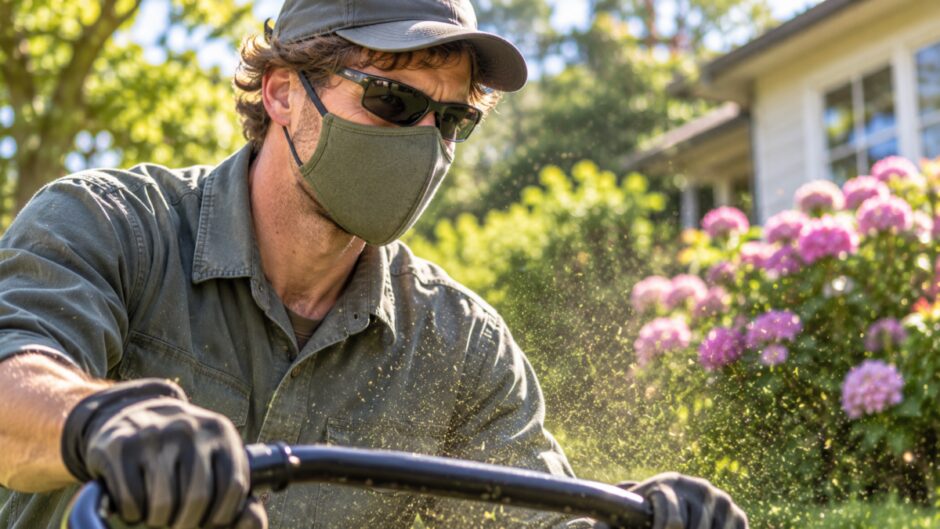

Spring is the worst two-month stretch of the year to be running a mower or a trimmer outdoors. Tree pollen peaks across most of the US from mid-March into April, right as landscaping and grounds crews ramp back up after winter. A mower or leaf blower doesn’t just expose you to that pollen, it kicks up grass clippings, dried dirt, and whatever dust was sitting on the lawn into the air you’re breathing all day.
This guide covers what the research actually shows about dust and pollen exposure in landscaping work, what to check before buying a mask for it, and five options available on Amazon right now.
This is a spec-based roundup: none of the masks below has been used by the author. This also isn’t medical advice: if you have diagnosed asthma, occupational allergies, or a respiratory condition, that’s a conversation for a doctor or an occupational health provider, not a buying guide.
A Hazard OSHA Treats as Voluntary, Until It Isn’t
Under OSHA’s respiratory protection standard (29 CFR 1910.134), an N95 or similar filtering facepiece worn voluntarily doesn’t require a written respiratory protection program, a medical evaluation, or fit testing. The employer still has to hand the worker a copy of the standard’s Appendix D, explaining proper use and limitations.
The catch is in the word “voluntary.” If dust or airborne particulate at a job site is actually significant enough to be a respiratory hazard, not just an annoyance, OSHA’s voluntary-use exception stops applying, and the employer is supposed to run a full program instead: exposure assessment, medical evaluation, fit testing. In practice, a landscaping crew member deciding on their own to wear a mask on a dusty mowing day is almost always in “voluntary” territory. Whether it should be is a separate question from whether it currently is.
What the Research Actually Says
A 2025 field study in the Journal of Occupational and Environmental Hygiene measured real exposures across 80 landscaping workers at 11 worksites. Most of what it found was about noise (94 of 119 full-shift measurements exceeded NIOSH’s recommended limit), but it also measured respirable crystalline silica from tools like saws and grinders, and found four non-hardscaper workers exposed above the limit even where dust-control equipment was in use. The takeaway for this guide is narrow but real: landscaping tools generate measurable, sometimes unsafe, airborne dust, and engineering controls alone don’t always bring it under the limit.
On pollen specifically, the picture is more mixed than “landscapers are more allergic.” A 1994 study of 128 municipal lawn cutters, published in the Journal of Allergy and Clinical Immunology, found grass-pollen sensitization rates about the same as a control group of non-outdoor municipal workers (18% vs. 22%). What was elevated was mold sensitization: 12% among lawn cutters versus 5% in the control group, consistent with the mix of decaying plant matter a mower kicks up. Separately, case reports in the allergy literature document occupational asthma triggered specifically by grass juice released during mowing, a real but individual-level phenomenon, not evidence that mowing raises population-wide allergy rates.
Put together: the dust is the more consistently documented hazard. The pollen and mold risk is real for people who already react to them, but it’s not a story of landscapers becoming more allergic just by doing the job.
What to Check Before Buying
1. NIOSH Certification Means Something Specific
“N95” is a NIOSH certification: it means the respirator filters at least 95% of airborne particles in a standardized test, and the manufacturer has to prove it. A reusable “dust mask” with a carbon filter and a percentage printed on the packaging hasn’t necessarily been through that same certification process. That doesn’t make it useless, since carbon filters add real odor/VOC filtering an N95 doesn’t do, but treat “NIOSH N95” and “manufacturer-claimed filtration” as two different claims with two different levels of evidence behind them.
2. Fit Matters More Than the Spec Sheet
A respirator that doesn’t seal against your face lets unfiltered air in around the edges, regardless of what the filter itself is rated for. Facial hair is the single biggest factor here: a beard breaks the seal on almost any tight-fitting respirator, disposable or reusable. If that’s a factor, a loose-fitting powered air-purifying respirator is a different (and pricier) category not covered in this guide.
3. Replaceable Filters Change the Math on Cost
Disposable N95s are cheap per unit but become trash after one shift of heavy dust exposure. Reusable masks with replaceable carbon filters cost more upfront but spread that cost over months, worth factoring in if this is daily-use gear rather than an occasional-dusty-day purchase.
4. Breathability Under a Hot Sun
Spring mowing season overlaps with rising temperatures, and a mask that traps heat against your face makes an already-hot job worse. Mesh-backed and valved designs exhaust warm, humid breath instead of trapping it, worth weighing against raw filtration numbers if you’re wearing one for a full shift outdoors.
5. Compatibility With the Rest of Your PPE
Safety glasses, hearing protection, and a mask strap all compete for the same real estate around your ears and the bridge of your nose. Check how a given mask’s straps interact with glasses specifically, since fogging and strap conflicts are a common complaint with half-face designs.
5 Dust & Pollen Masks for Landscaping Work
Specs below are as listed by sellers, and none was tested by the author. Check each live listing for current specs, sizing, and filter contents.
1. 3M 8511 N95 Cool Flow Valved Respirator (10-Pack) — Best Known-Quantity Option
Good for: anyone who wants a NIOSH-certified respirator from a major, well-documented manufacturer
A NIOSH-approved N95 disposable respirator with a one-way exhalation valve to vent warm breath, which 3M markets specifically for dust, pollen, and mold spore relief. Disposable, not reusable, so budget for replacing it regularly during heavy-use season.
2. AccuMed/BNX N95 Mask (20-Pack) — Best Made-in-USA Option
Good for: crews or individuals who specifically want domestically manufactured, NIOSH-certified masks
A NIOSH-certified N95 respirator manufactured in the US, sold in a larger 20-pack, useful if you’re outfitting more than one person or want a deeper supply for a full mowing season without reordering.
3. BASE CAMP Family Pack Dust Mask — Best for Daily Reuse
Good for: landscapers who mow dusty conditions often enough that disposables get expensive
A reusable respirator mask with replaceable activated carbon filters, aimed at woodworking, construction, and mowing use. Not NIOSH-certified: the carbon filter adds odor filtering an N95 doesn’t, but treat the manufacturer’s filtration claim as a different kind of evidence than a NIOSH rating.
4. Threlaco Dust Mask (8-Pack) — Best Budget Reusable Bundle
Good for: outfitting a small crew, or keeping spares on hand without a large upfront cost
A reusable respirator with activated carbon filters marketed for woodworking, construction, and mowing, sold as an 8-piece bundle. Same non-NIOSH caveat as the BASE CAMP option above: check the listing for exactly what’s included (masks vs. filters) before buying.
5. RZ Mask M2.5 Superior Bundle Pack — Best for Hot-Weather Breathability
Good for: full-shift wear through spring heat, where a stuffy mask becomes its own problem
A reusable cooling-mesh mask with carbon filtration, marketed specifically for landscaping, pollen, and dust work, bundled with 8 filters. The mesh construction is the main differentiator here: it’s built to be breathable for all-day wear rather than maximum filtration alone.
| Mask | Type | NIOSH Certified | Best For |
|---|---|---|---|
| 3M 8511 (10-Pack) | Disposable N95 | Yes | Known-quantity, major brand |
| AccuMed/BNX (20-Pack) | Disposable N95 | Yes | Made in USA, bulk supply |
| BASE CAMP Family Pack | Reusable, carbon filter | No | Daily reuse |
| Threlaco (8-Pack) | Reusable, carbon filter | No | Budget / outfitting a crew |
| RZ Mask M2.5 Superior | Reusable, cooling mesh | No | Hot-weather, all-day wear |
How to Pick
- You want the most-documented filtration claim → 3M 8511 or AccuMed/BNX (both NIOSH-certified N95)
- You’re outside in dust most days and want to stop buying disposables → BASE CAMP or Threlaco
- Full-shift wear in spring heat is the main complaint → RZ Mask M2.5 Superior
FAQ
Does a dust mask also protect against grass pollen?
A properly sealed N95 filters particles in the size range that includes pollen grains, so yes in principle. Research on lawn cutters specifically found pollen sensitization rates similar to non-outdoor workers, but mold sensitization was higher, so the mask is doing real work against something, even if it isn’t dramatically cutting your odds of becoming allergic to grass.
Do I legally need to wear one for mowing work?
Generally no, unless dust levels at a specific site are high enough to count as a documented hazard, which shifts it from OSHA’s voluntary-use category into a mandatory respiratory protection program. For most routine mowing, this is a personal decision, not a legal requirement.
Is a reusable mask with a carbon filter as good as an N95?
They’re answering different questions. NIOSH N95 certification is a tested, verified particle-filtration standard. A carbon filter adds odor and VOC filtering N95s don’t do, but unless the product specifically carries a NIOSH rating, its particle-filtration claim hasn’t been through the same independent testing.
Will a mask make summer heat worse?
It can, especially tight-sealing designs with no exhalation valve. Valved N95s and mesh-backed reusable designs are built specifically to reduce that tradeoff, worth prioritizing if you’re wearing one for a full shift rather than short bursts.
What if I have a beard?
Facial hair breaks the seal on tight-fitting respirators, disposable or reusable, regardless of filtration rating. A loose-fitting powered air-purifying respirator doesn’t rely on a facial seal, but that’s a different, pricier product category than what’s compared here.
Specs above are manufacturer-stated figures as of publication. Check each product page for current pricing, specifications, and availability before buying.
More Heat & Safety Guides
This site covers gear for a range of outdoor jobs, each with its own buying considerations:
- Cooling Vests for Farm & Landscaping Work
- Cooling Vests for the Job Site (Construction)
- Cooling Vests for Traffic Control & Security
- Cooling Vests for Delivery Drivers & Motorcycle Couriers
- Cooling Vests for Sanitation & Outdoor Cleaning Crews
- Cooling Vests for Forestry & Logging Work
- Fan Cooling Vest for Fishing (Fishermen & Anglers)