Panda Works Club


For crop crews and mowing and landscaping crews alike, summer heat isn’t an abstraction. It’s hours of direct sun with no shade structure in sight, often made worse by the exhaust heat off a mower or brush cutter running right next to you, in a year that already set US and European heat records. Farm work is frequently piece-rate, which turns stopping for a break into a real financial tradeoff rather than a simple choice; landscaping crews run on tight route schedules that create a similar pressure to keep moving.
Unlike construction or warehousing, agricultural heat safety has actually been studied in the field by researchers, not just marketed by vest manufacturers, and landscaping and grounds maintenance shows up explicitly alongside farming in federal data on which outdoor jobs carry the most risk. This guide covers what that research actually found, what to check before buying a cooling vest for field or landscaping work, and five fan-powered options available on Amazon right now.
Where Fan Cooling Vests Come From: A Japanese Invention
This entire product category has a specific origin, not a vague “ancient technique” story. In the 1990s, Hiroshi Ichigaya, a former Sony engineer, tried circulating water through a prototype garment to cool himself on a hot business trip; the tank kept leaking. He switched approaches: small fans that pull in outside air and speed up the evaporation of sweat. He patented the design and brought it to market in 2004 under the name kuchofuku (空調服), literally “air-conditioned clothing.”
The mechanism is the same one doing the work in every vest compared in this guide: fans near the waist draw in ambient air, and evaporating sweat does the cooling. It isn’t a refrigerant, and the vest itself isn’t lowering the air temperature.
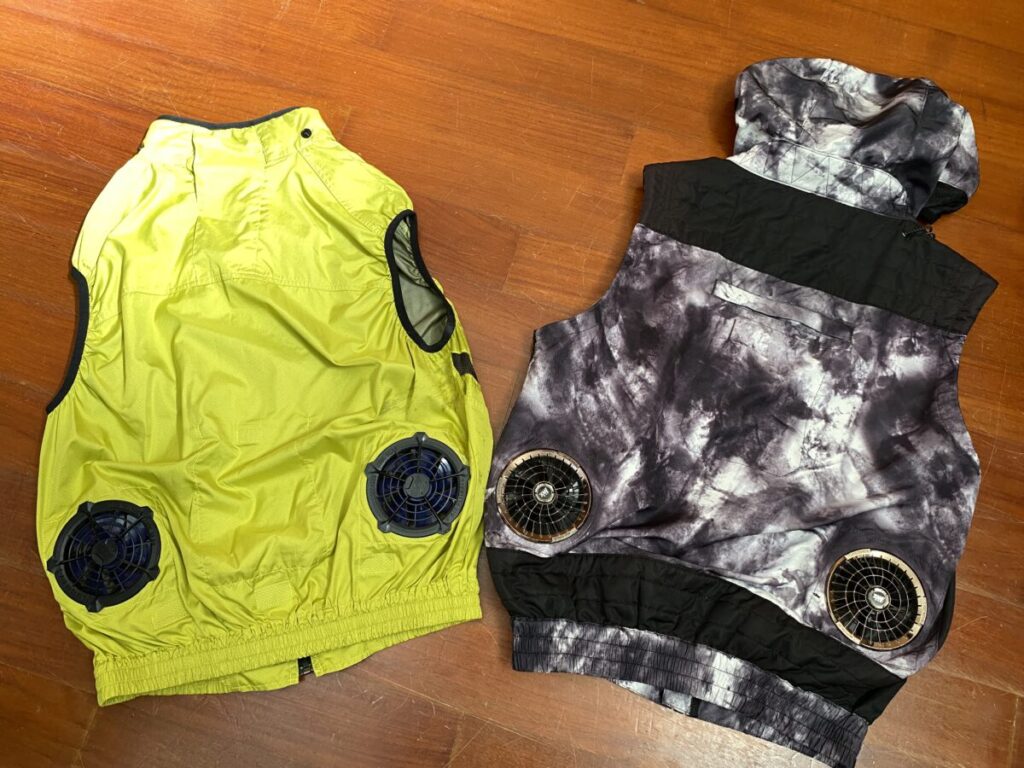
The category didn’t stay a niche product. A 2011 AFP report, amid a nationwide push to cut power use after the Fukushima disaster, put the number of Japanese companies issuing Kuchofuku’s gear to staff at nearly 1,000, including automakers, steelmakers, food manufacturers, and construction firms. It’s kept growing since: Japanese trade press (Sen-i News) estimated the domestic electric-fan-workwear market at roughly ¥20 billion in 2024, with newer entrants like Burtle now reported to hold close to half of shipment value, alongside the original Kuchofuku brand and Sun-S’s competing “kuchofuku-fujinfuku” line.
None of the vests compared below are official Kuchofuku products. They’re independent brands sold on Amazon, but they’re built on the same fan-and-evaporation design this Japanese invention started.
Sources: Government of Japan, “Cooling the Body with Fan-Equipped Clothes”; Web Japan, “Air-Conditioned Clothes”; AFP, “Air-conditioned clothes help Japan beat heat” (2011); Sen-i News market reporting (2024–2025).
A Patchwork of Protection, Not a National Standard
There’s still no federal OSHA heat standard: the proposed rule has been in rulemaking since 2024, with a supplemental proposal expected later this year and final action not likely before 2027. OSHA’s Heat National Emphasis Program, briefly lapsed, then renewed on April 10, 2026 for five years through 2031, explicitly names landscaping alongside agriculture among its targeted high-risk outdoor industries, and triggers random inspections on any day the National Weather Service issues a heat advisory. It’s an enforcement priority, not a binding standard on its own.
For agriculture specifically, protection currently depends on which state a farm operates in. California has required shade, water, training, and a written plan for outdoor agricultural work since 2005, the longest-running state standard in the country, triggered at 80°F. Colorado’s rule is written specifically for agricultural workers, mandating shade, water, and paid rest breaks in high-heat conditions. Minnesota’s standard covers agricultural settings alongside indoor and industrial work. Virginia directed its Safety and Health Codes Board to develop heat rules in April 2026, and Illinois and Arizona are both mid-rulemaking. These state standards are generally written around agricultural work specifically. Landscaping crews in most states fall back to OSHA’s general duty clause, the same thinner protection farmworkers outside those states rely on. Researchers studying this gap have specifically flagged outdoor crews broadly as a population with disproportionately weak regulatory protection relative to their heat exposure.
Grounds maintenance and landscaping workers don’t have a heat-specific death rate this precise: no dedicated heat-only count exists yet for this occupation the way it does for crop workers above, which is itself a reasonable sign that landscaping heat risk is under-studied relative to how exposed the job actually is. What’s confirmed instead is the regulatory signal: OSHA’s own Heat National Emphasis Program names landscaping specifically as a high-risk outdoor industry worth targeted inspection attention.
What the Research Actually Says About Cooling Vests
This is one of the few corners of the cooling-gear market with real field research behind it, not just marketing copy. Studies on phase-change (ice-pack) cooling vests among agricultural workers, including CDC-affiliated field research by Chicas et al., found real physiological benefit: lower clothing microclimate temperature and reduced sweat rate while wearing one. But the same research found a practical problem specific to ice-pack vests: workers reported them becoming uncomfortable and heavy once the packs melted, which led researchers to suggest ice-pack vests may be better suited to rest breaks than continuous wear during active field work. A 2026 paper in the American Journal of Industrial Medicine, “Beyond Water, Rest, and Shade,” continues to push for farmworker heat protection that goes beyond those three basics.
That melting-weight problem is specific to ice and gel-pack vests. A battery-powered fan or Peltier vest has no mass to melt. The tradeoff moves instead to battery weight and runtime, which is a different problem but at least a stable one across a full shift.
5 Things to Check Before Buying
1. Voltage Isn’t the Whole Story
Listings market cooling vests on voltage (21V, 30V, occasionally more) because it’s a single number that’s easy to compare. What that number leaves out is airflow path: a vest worn under a long-sleeve sun shirt, with the cuffs and hem sealed tight against dust, won’t move air any better than a far cheaper model. Voltage sets the ceiling; how you wear it decides whether you ever get close to it.
2. Battery Life Over a Full Row, Not Just a Lab Test
The runtime figure on the listing is almost always measured at the lowest fan speed, since that’s the number that looks best. In the field on a hot day you’ll run the vest at medium or high, where real runtime often lands at a third of the advertised number. For a full day with no outlet nearby, 20,000mAh is a reasonable minimum, and a charged spare battery is worth treating as standard kit rather than a backup plan.
3. Weight and Mobility, Whether You’re Bending or Walking a Route
Field work means bending, kneeling, and moving over uneven rows; landscaping and mowing work means covering ground on foot behind or alongside equipment for hours at a stretch. Either way, it’s not standing at a fixed station. The lightest vest that still delivers real airflow tends to win out over a bulkier high-voltage model, especially over a full shift of repetitive motion. This is also where ice-pack vests’ melting-weight problem matters most: a fan vest’s weight stays constant all day.
4. Dust, Clippings, and Fabric Durability
Fields are dusty, and a mower or brush cutter throws grass clippings and debris the same way, and fabric gets snagged or coated in a way it rarely does on a construction site. A durable, abrasion-resistant fabric matters more here than it would in an office or warehouse setting, so check the fabric type and any reinforcement the listing mentions.
5. Reading Past the Marketing Numbers
A vest claiming to cool “-24°C” isn’t promising a 24-degree drop in the air around you. That figure is a lab measurement of the cooling plate itself under controlled conditions, not what you’d feel standing in a field at noon. The claim isn’t dishonest so much as answering a question nobody actually asked. Treat these numbers as a starting point for comparison, not a guarantee.
What follows is pulled directly from each manufacturer’s listing. Check the product page for current pricing and specifications before buying.
5 Cooling Vests for Field & Landscaping Work (2026)
1. MIDIAN 30V Cooling Jacket — Best for Full Sun Coverage
Good for: open fields and open lawns with zero shade structure, orchard and row-crop work, all-day mowing routes
A long-sleeve jacket in 100% cotton rated to block over 98% of UV rays, with an open-back “3D wind duct” design and a 20,000mAh battery across five speeds, rated up to roughly 10 hours at a moderate setting. The long sleeves add real sun protection over bare arms in a field or on a lawn with no shade for hours at a time.
2. Lvkakmox 21V Cooling Fan Vest — Best Lightweight Option for Repetitive Field Work
Good for: bending, kneeling, and repetitive motion over a full shift
A sleeveless vest with two fans rated up to 12,000 RPM and a 20,000mAh battery that stretches to roughly 16 hours on its lowest of four speeds. Being sleeveless and lighter than a full jacket, it’s the easiest of the five to move freely in over a long day of picking or weeding. Also sold in a reflective “Safety” trim.
3. LABEWVI 30V Cooling Vest — Best Fast Charging
Good for: crews who can top off a battery midday on Type-C power
Five speed settings from roughly 7,100 RPM down to 4,100 RPM, with the same 20,000mAh capacity as the others but Type-C fast charging, useful if other gear (phone, two-way radio) already charges the same way back at the barn or equipment shed.
4. LABEWVI Semiconductor Peltier Vest — Best Fan-Free Option
Good for: dusty fields or mowing work where fan intake clogging with grass clippings is a real concern
No fans at all: two Peltier (thermoelectric) modules cool the vest directly, with three modes the manufacturer rates down to -24°C, -20°C, and -16°C relative to skin temperature (see the note above on reading these numbers). Runtime drops to around 3 hours on the coldest setting, but having no fan intake to pull dust, pollen, or clippings through is a genuine practical advantage behind a mower or in a dry field.
5. Foiueyga 4-Fan Cooling Vest — Best Budget Pick for Outfitting a Crew
Good for: trying the category out, or buying for multiple seasonal workers at once
A short-sleeve, 4-fan vest on a smaller 10,000mAh battery at 7.4V, noticeably less powerful than the others, with up to roughly 6 hours of runtime on the highest setting. It’s the lowest-priced option here, and the nylon fabric is specifically described as water-resistant, which also helps against morning dew and irrigation spray.
| Model | Type | Speeds | Battery | Fabric | Best For |
|---|---|---|---|---|---|
| MIDIAN 30V Jacket | Fan | 5 (30V–9V) | 20,000mAh | Cotton, UV-block | Full sun, open field |
| Lvkakmox 21V Vest | Fan | 4 (21V–15V) | 20,000mAh | Nylon | Lightweight, repetitive work |
| LABEWVI 30V Vest | Fan | 5 (30V–15V) | 20,000mAh, Type-C | Polyester | Fast charging |
| LABEWVI Peltier Vest | Peltier | 3 (-24°C to -16°C) | 20,000mAh, Type-C | Polyester | Dusty conditions, no fan intake |
| Foiueyga 4-Fan Vest | Fan | 4 (7.4V) | 10,000mAh | Nylon, water-resistant | Budget / outfitting a crew |
Which One Should You Get?
- Open field, zero shade all day → MIDIAN 30V Jacket
- Bending and kneeling over a full shift → Lvkakmox 21V Vest
- Charging gear via USB-C back at the barn → LABEWVI 30V Vest
- Dry, dusty field conditions → LABEWVI Peltier Vest
- Buying for several seasonal workers at once → Foiueyga 4-Fan Vest
Troubleshooting a Vest That Doesn’t Seem to Help
Before assuming a vest is defective, run through three quick checks:
- Is there actually an air exit point? A sealed cuff or hem traps the air the fans are pushing instead of letting it circulate, so check whether the garment is cinched shut anywhere it shouldn’t be.
- What’s underneath it? A cotton T-shirt holds sweat against your skin instead of letting it evaporate, which is the whole mechanism these vests rely on. Swapping in a wicking layer is a cheap fix that often matters more than the vest itself.
- Is it being asked to do too much on its own? The research cited above is consistent: cooling gear is most effective paired with scheduled breaks and hydration, not as a stand-in for them.
FAQ
Do cooling vests actually work for farm workers, or is that just marketing?
Field research on phase-change (ice-pack) vests among agricultural workers has found real benefits, including lower clothing microclimate temperature and reduced sweat rate, though the same research found ice-pack vests become heavy and uncomfortable once the packs melt, which made them better suited to breaks than continuous wear. Battery-powered fan and Peltier vests avoid that specific melting-weight problem, though they haven’t been studied as extensively in the same academic literature.
Is a cooling vest a substitute for water and shade breaks?
No. Every piece of research in this space treats cooling gear as an addition to water, rest, and shade, not a replacement for them. States with agricultural heat rules, including California and Colorado, still mandate those basics regardless of what gear a worker wears.
Does a higher voltage always mean a cooler vest in the field?
Not on its own. A higher-voltage vest can push more air, but sun shirts, gloves, and sealed cuffs worn for sun and crop protection can block that airflow just as easily as they would on a cheaper model.
Will I get the full advertised runtime for a day of picking or weeding?
Probably not: the advertised number is almost always the lowest-speed figure. At the medium-to-high speed you’d actually run on a hot day, plan for meaningfully less, and keep a charged spare battery on hand for a full shift.
What should go on under a cooling vest in the field?
A moisture-wicking layer rather than cotton. The cooling comes from sweat evaporating off your skin, and a cotton shirt traps that moisture instead of letting it evaporate.
Can these be washed after a dusty day in the field?
Most vests can be machine- or hand-washed once the fans and battery are removed. Check the specific product’s care instructions, since this varies by model. Never submerge the fan units or battery pack.
Does this apply to landscaping and mowing crews, not just farm workers?
Yes. OSHA’s own Heat National Emphasis Program names landscaping specifically alongside agriculture as a high-risk outdoor industry, and the heat exposure behind a mower or brush cutter is physically the same problem as standing in a field: direct sun plus hard physical work, often with engine exhaust heat added on top. The buying advice above, especially on dust/debris and fan-intake clogging, applies just as directly to mowing work as it does to row crops.
Bottom Line
Choosing a cooling vest for field or landscaping work comes down to real runtime at the speed you’ll actually use, weight you can move freely in over a full shift, and durability against dust, clippings, and debris, not the biggest number on the listing. The research on crop workers specifically is clearer than it is for most cooling-gear categories: these vests genuinely help, but only as part of a plan that still includes water, shade, and real breaks. Landscaping crews face the same heat exposure without the benefit of that same research base. OSHA already names the industry as high-risk, even where a specific heat-death count doesn’t exist yet.
Specs above are manufacturer-stated figures as of publication. Check each product page for current pricing, specifications, and availability before buying.
More Heat Safety Guides
This site covers cooling vests for a range of outdoor jobs, each with its own buying considerations:
- Cooling Vests for the Job Site (Construction)
- Fan Cooling Vest for Fishing (Fishermen & Anglers)
- Cooling Vests for Traffic Control & Security
- Cooling Vests for Delivery Drivers & Motorcycle Couriers
- Cooling Vests for Sanitation & Outdoor Cleaning Crews
- Cooling Vests for Forestry & Logging Work