Panda Works Club

Between 2015 and 2022, at least 143 UPS employees were hospitalized for heat-related injuries, and several drivers have died on the job during extreme heat: José Cruz Rodriguez in Waco in 2021, Luis Grimaldo in Bell County, Christopher Begley after collapsing at a 108°F heat index. The reason is almost mundane: of roughly 100,000 package trucks on US roads, only about 6,000 have air conditioning, and a closed cargo area routinely runs 20–25°F hotter than the outside air. UPS is contractually required to add 28,000 AC-equipped trucks by 2028, which tells you how far from solved this still is in 2026.
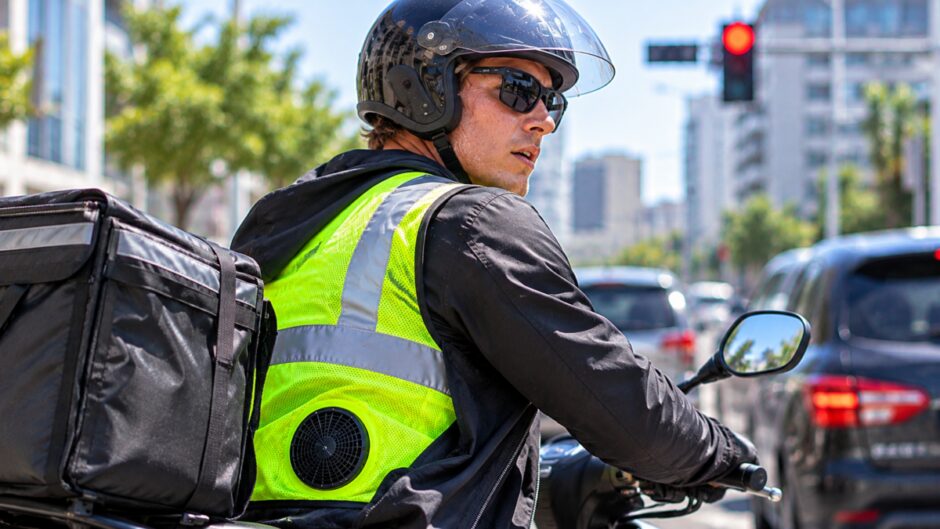
Motorcycle and scooter couriers face a different version of the same problem. At highway speed, wind does a lot of the cooling for you; in the stop-and-go reality of city delivery (idling at lights, parked outside a restaurant, walking a bag up three flights of stairs), that wind disappears and the heat trapped under a riding jacket doesn’t. This guide covers what actually helps in both situations, and five vests available on Amazon right now.
Where Fan Cooling Vests Come From: A Japanese Invention
This entire product category has a specific origin, not a vague “ancient technique” story. In the 1990s, Hiroshi Ichigaya, a former Sony engineer, tried circulating water through a prototype garment to cool himself on a hot business trip; the tank kept leaking. He switched approaches: small fans that pull in outside air and speed up the evaporation of sweat. He patented the design and brought it to market in 2004 under the name kuchofuku (空調服), literally “air-conditioned clothing.”
The mechanism is the same one doing the work in every vest compared in this guide: fans near the waist draw in ambient air, and evaporating sweat does the cooling. It isn’t a refrigerant, and the vest itself isn’t lowering the air temperature.
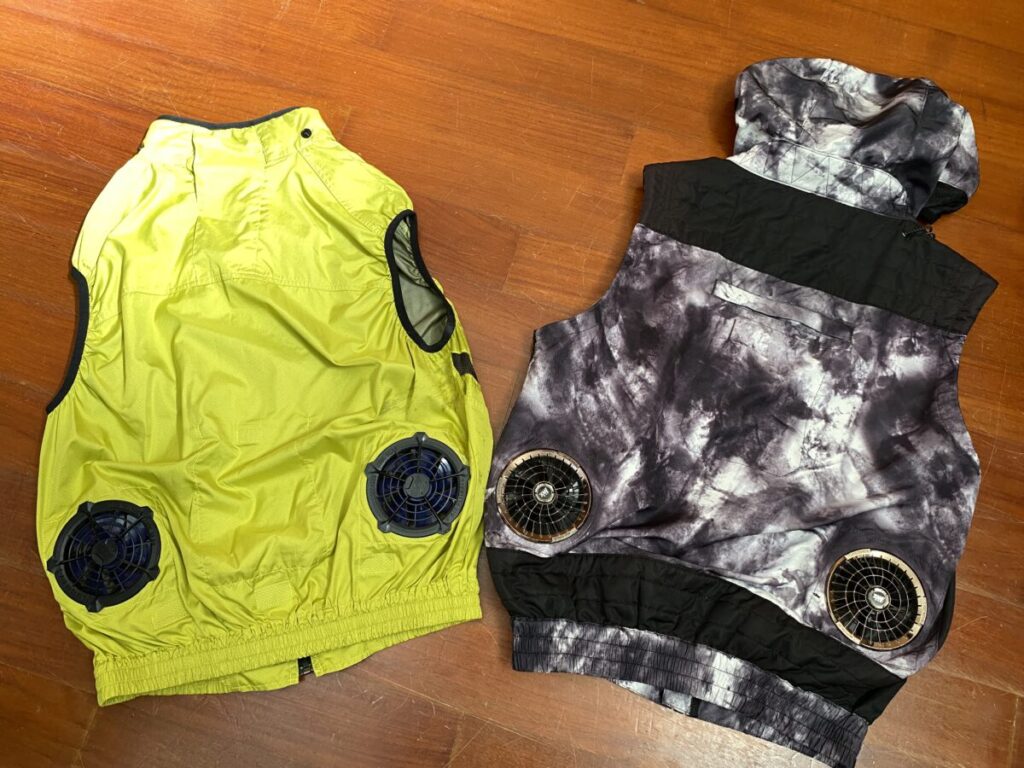
The category didn’t stay a niche product. A 2011 AFP report, amid a nationwide push to cut power use after the Fukushima disaster, put the number of Japanese companies issuing Kuchofuku’s gear to staff at nearly 1,000, including automakers, steelmakers, food manufacturers, and construction firms. It’s kept growing since: Japanese trade press (Sen-i News) estimated the domestic electric-fan-workwear market at roughly ¥20 billion in 2024, with newer entrants like Burtle now reported to hold close to half of shipment value, alongside the original Kuchofuku brand and Sun-S’s competing “kuchofuku-fujinfuku” line.
None of the vests compared below are official Kuchofuku products. They’re independent brands sold on Amazon, but they’re built on the same fan-and-evaporation design this Japanese invention started.
Sources: Government of Japan, “Cooling the Body with Fan-Equipped Clothes”; Web Japan, “Air-Conditioned Clothes”; AFP, “Air-conditioned clothes help Japan beat heat” (2011); Sen-i News market reporting (2024–2025).
A Regulatory Gap That’s Mostly About Employment Status
Delivery work splits into two very different categories under US law, and it matters which one you’re in. Drivers classified as employees (most UPS, FedEx Ground, and Amazon DSP drivers) are nominally covered by OSHA’s general duty clause and whatever state heat rules apply where they work. Drivers classified as independent contractors (most DoorDash, Uber Eats, Instacart, and gig-app couriers) generally aren’t, because the Occupational Safety and Health Act protects employees, and the independent-contractor label is also what lets platforms avoid responsibility for wages, breaks, and workers’ compensation. A 2026 California court ruling narrowed that shield slightly, holding that Cal/OSHA doesn’t have to first prove a worker was a legal employee before it can investigate a workplace death, but that’s a narrow opening, not a heat standard. In practice, most gig delivery workers’ heat protection currently amounts to push notifications reminding them to stay hydrated.
OSHA’s own federal heat rule is still pending (proposed in 2024, with a supplemental proposal expected later this year and final action not likely before 2027), and its Heat National Emphasis Program (renewed April 2026 through 2031) covers delivery and warehousing among its high-risk industries. None of that currently reaches a driver working through an app rather than a paycheck.
Fan Vests Make More Sense for Some Delivery Work Than Others
It’s worth being honest about where a battery-powered fan vest actually helps here, because the answer isn’t the same for every kind of delivery work. For a van or truck driver without cab AC, it’s a clear win: you’re sitting or standing in trapped heat with no wind at all, in and out of the vehicle repeatedly. For a motorcycle or scooter rider at real riding speed, the vest is competing with wind you’re already getting for free, so the benefit shows up mainly when you’re stopped, idling, or walking, which, for city food delivery, can be a large share of an actual shift. A fitted riding jacket worn over a fan vest can also seal the cuffs and vents shut, which defeats the vest the same way a harness or duty belt would elsewhere; check how (and whether) a vest is meant to be worn under riding gear before buying.
5 Things to Check Before Buying
1. Will It Actually Fit Under Your Jacket or Uniform?
A vest that works great on its own can stop working once it’s compressed under a riding jacket, a company polo, or a safety vest. Bulk at the fan housings matters more here than almost anywhere else in this series. Check the listed thickness and whether the fans sit flat enough to layer under what you already have to wear.
2. Battery Life Across a Full Shift, Not a Lab Test
The runtime figure on a listing is almost always the lowest-speed number. A delivery shift can run 8 to 12 hours with no real break room to recharge in, so 20,000mAh is a reasonable floor, and a charged spare is worth factoring into the actual cost of the gear, especially for gig workers who are buying this out of pocket with no reimbursement coming.
3. Voltage Means Less When You’re Already Moving
Higher voltage pushes more air, but on a motorcycle at speed you’re already getting airflow the vest doesn’t need to generate. The spec matters most exactly when you’re not moving: stopped at a light, parked, or walking an order to a door, which is worth keeping in mind when comparing voltage numbers between vests aimed at different kinds of delivery work.
4. Quiet Operation, If You’re Running Comms or a Headset
Fan noise is a minor annoyance in a warehouse and a real one under a helmet with intercom or navigation audio running. A Peltier (fan-free) vest trades runtime for silence, which is a fair trade for some riders and a bad one for drivers doing a full day in a van cab with no comms to protect.
5. Reading Past the Marketing Numbers
“-24°C cooling” is a lab measurement of the cooling plate itself, not a promise about how the air around you will feel on a delivery route in August. Treat these figures as a loose signal, not a literal temperature drop you’ll experience.
Specs below come straight from each listing. Confirm current pricing and availability on the product page before buying.
5 Cooling Vests for Delivery Drivers & Couriers (2026)
1. MIDIAN 30V Cooling Jacket — Best for Van & Truck Drivers
Good for: no-AC cargo vans and trucks, frequent loading/unloading in direct sun
A long-sleeve jacket in 100% cotton rated to block over 98% of UV rays, with an open-back “3D wind duct” design and a 20,000mAh battery across five speeds, rated up to roughly 10 hours at a moderate setting. The long sleeves help on the loading-dock and curbside stretches of a route, not just behind the wheel.
2. Lvkakmox 21V Cooling Fan Vest — Best Under a Riding Jacket
Good for: motorcycle and scooter couriers layering under riding gear
A sleeveless vest with two fans rated up to 12,000 RPM and a 20,000mAh battery stretching to roughly 16 hours on its lowest of four speeds. Sleeveless and thin by the standards of this category, it’s the one in this lineup most likely to actually fit under a fitted riding jacket without fighting it for space.
3. LABEWVI 30V Cooling Vest — Best Fast Charging Between Shifts
Good for: drivers who can top off a battery at a depot, home base, or mid-shift break
Five speed settings from roughly 7,100 RPM down to 4,100 RPM, with a 20,000mAh battery and Type-C fast charging, useful if your phone, headset, and navigation device already run on the same charging cable.
4. LABEWVI Semiconductor Peltier Vest — Best for Headsets & In-Cab Comms
Good for: riders running intercom audio, drivers who want silence in the cab
No fans at all: two Peltier (thermoelectric) modules cool the vest directly, with three modes the manufacturer rates down to -24°C, -20°C, and -16°C relative to skin temperature (see the note above on reading these numbers). Runtime drops to around 3 hours on the coldest setting, but it’s the only option here that won’t compete with a helmet intercom or a cab radio.
5. Foiueyga 4-Fan Cooling Vest — Best for Gig Workers Buying Their Own Gear
Good for: independent contractors paying out of pocket with no employer reimbursement
A short-sleeve, 4-fan vest on a smaller 10,000mAh battery at 7.4V, noticeably less powerful than the others, with up to roughly 6 hours of runtime on the highest setting. It’s the lowest-priced option here, which matters more in this category than most: a gig courier buying their own heat-safety gear with no company footing the bill is a genuinely different financial position than an employee whose employer supplies PPE.
| Model | Type | Speeds | Battery | Fabric | Best For |
|---|---|---|---|---|---|
| MIDIAN 30V Jacket | Fan | 5 (30V–9V) | 20,000mAh | Cotton, UV-block | Van / truck drivers |
| Lvkakmox 21V Vest | Fan | 4 (21V–15V) | 20,000mAh | Nylon | Under a riding jacket |
| LABEWVI 30V Vest | Fan | 5 (30V–15V) | 20,000mAh, Type-C | Polyester | Fast charging |
| LABEWVI Peltier Vest | Peltier | 3 (-24°C to -16°C) | 20,000mAh, Type-C | Polyester | Headsets / comms |
| Foiueyga 4-Fan Vest | Fan | 4 (7.4V) | 10,000mAh | Nylon, water-resistant | Budget / gig workers |
Which One Should You Get?
- Driving a non-AC cargo van or truck → MIDIAN 30V Jacket
- Riding a motorcycle or scooter, need it under a jacket → Lvkakmox 21V Vest
- Can charge via USB-C during the shift → LABEWVI 30V Vest
- Running a headset or in-cab radio, want it quiet → LABEWVI Peltier Vest
- Paying for this yourself as a gig worker → Foiueyga 4-Fan Vest
Three Reasons It Might Not Feel Like It’s Helping
If a vest feels like it isn’t earning its keep, the cause is usually one of these rather than the hardware itself. A riding jacket or uniform zipped up tight over it seals off the air exit point, the same problem a duty belt or harness causes in other jobs: the fans are still running, the air just has nowhere to go. Expecting the same effect while cruising at highway speed as when stopped is another common mismatch: a fan vest’s real contribution shows up at idle, in stop-and-go traffic, and on foot, not when wind is already doing the cooling for free. And what’s worn underneath matters as much as the vest itself: a cotton undershirt holds sweat against your skin instead of letting it evaporate, which is the entire mechanism these vests depend on.
FAQ
Are gig delivery drivers covered by any heat safety regulations?
Mostly not, as a practical matter. OSHA protections apply to employees, and most app-based couriers are classified as independent contractors rather than employees, which has historically put heat safety outside the agency’s direct reach for that group. A 2026 California court ruling gave Cal/OSHA more room to investigate gig-worker deaths regardless of classification disputes, but that’s narrower than an actual heat standard.
Does a cooling vest even help on a motorcycle, since you’re already getting wind?
Less at highway speed, more in city stop-and-go conditions. The vest’s contribution is largest when you’re stopped, idling, or walking, which can be a significant share of an actual delivery shift, and smaller once you’re moving fast enough to get real wind cooling for free.
Why don’t more delivery trucks have air conditioning?
Mostly cost and fleet-replacement timelines. As of recent reporting, only a small fraction of US package delivery trucks have AC, and large carriers like UPS are working through multi-year contractual commitments to retrofit or replace their fleets rather than doing it all at once.
Will a fan vest actually fit under my uniform or riding jacket?
It depends on the vest and the jacket: bulk at the fan housings is the main constraint. Sleeveless, thinner vests generally layer better than a full long-sleeve jacket under fitted riding gear.
What should I wear underneath a cooling vest?
A moisture-wicking layer rather than cotton, since the cooling effect relies on sweat evaporating rather than being trapped against your skin.
Bottom Line
For van and truck drivers without cab AC, a cooling vest is close to a straightforward win: there’s no natural airflow competing with it. For motorcycle and scooter couriers, it matters most exactly where delivery work is worst: stopped, idling, or on foot between the bike and the door, not cruising at speed. And for the growing share of delivery workers classified as independent contractors, buying and maintaining this kind of gear is currently a personal cost rather than a provided one, which is itself a reasonable argument for prioritizing runtime and durability over the lowest possible price.
Specs above are manufacturer-stated figures as of publication. Check each product page for current pricing, specifications, and availability before buying.
More Heat Safety Guides
This site covers cooling vests for a range of outdoor jobs, each with its own buying considerations:
- Cooling Vests for the Job Site (Construction)
- Fan Cooling Vest for Fishing (Fishermen & Anglers)
- Cooling Vests for Farm & Landscaping Work
- Cooling Vests for Traffic Control & Security
- Cooling Vests for Sanitation & Outdoor Cleaning Crews
- Cooling Vests for Forestry & Logging Work