Panda Works Club
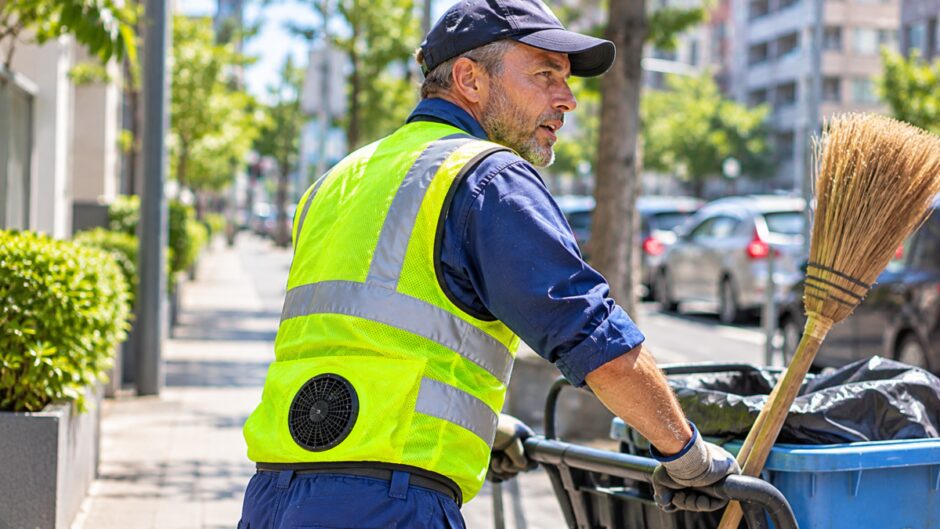

Solid waste collection is one of the more dangerous jobs in the US, and most of that risk is about trucks, not temperature: falling off the back step, being backed into, getting struck by a passing vehicle. Heat is a real but smaller line item on that list. It shows up anyway: 56% of refuse collectors report routine exposure to extreme hot or cold temperatures on the job, and a route that starts before dawn to beat traffic still often runs well into the hottest part of the afternoon.
This isn’t a hypothetical fix. In Nanjing, China, sanitation workers have been testing battery-powered fan vests, two quiet fans circulating air to speed up sweat evaporation, specifically for long summer shifts on the street. The same basic hardware is sold on Amazon today. This guide covers what to check before buying one for sanitation, street sweeping, or outdoor custodial work, and five options available now.
Where Fan Cooling Vests Come From: A Japanese Invention
This entire product category has a specific origin, not a vague “ancient technique” story. In the 1990s, Hiroshi Ichigaya, a former Sony engineer, tried circulating water through a prototype garment to cool himself on a hot business trip; the tank kept leaking. He switched approaches: small fans that pull in outside air and speed up the evaporation of sweat. He patented the design and brought it to market in 2004 under the name kuchofuku (空調服), literally “air-conditioned clothing.”
The mechanism is the same one doing the work in every vest compared in this guide: fans near the waist draw in ambient air, and evaporating sweat does the cooling. It isn’t a refrigerant, and the vest itself isn’t lowering the air temperature.
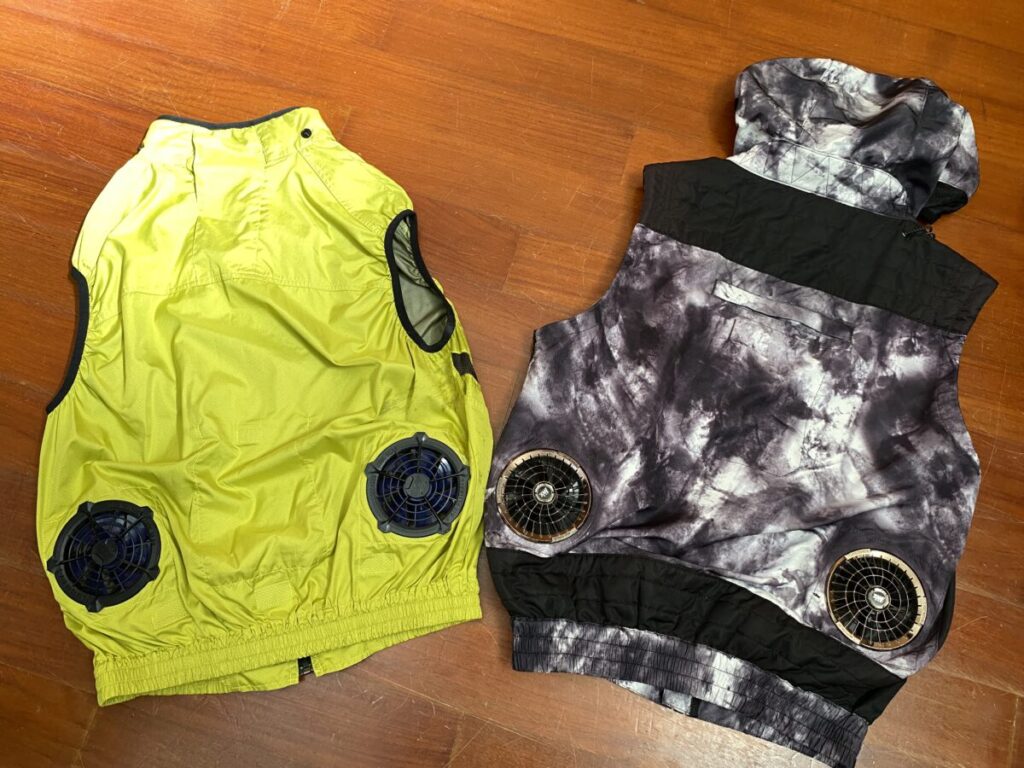
The category didn’t stay a niche product. A 2011 AFP report, amid a nationwide push to cut power use after the Fukushima disaster, put the number of Japanese companies issuing Kuchofuku’s gear to staff at nearly 1,000, including automakers, steelmakers, food manufacturers, and construction firms. It’s kept growing since: Japanese trade press (Sen-i News) estimated the domestic electric-fan-workwear market at roughly ¥20 billion in 2024, with newer entrants like Burtle now reported to hold close to half of shipment value, alongside the original Kuchofuku brand and Sun-S’s competing “kuchofuku-fujinfuku” line.
None of the vests compared below are official Kuchofuku products. They’re independent brands sold on Amazon, but they’re built on the same fan-and-evaporation design this Japanese invention started.
Sources: Government of Japan, “Cooling the Body with Fan-Equipped Clothes”; Web Japan, “Air-Conditioned Clothes”; AFP, “Air-conditioned clothes help Japan beat heat” (2011); Sen-i News market reporting (2024–2025).
Where This Fits in a Thin Regulatory Picture
There’s still no federal OSHA heat standard: the proposed rule has been in rulemaking since 2024, with a supplemental proposal expected later this year and final action not likely before 2027. OSHA’s Heat National Emphasis Program, renewed on April 10, 2026 for five years through 2031, targets 55 high-risk industries and triggers random inspections on days the National Weather Service issues a heat advisory. Outside the handful of states with their own heat illness prevention standards (California, Colorado, Maryland, Minnesota, Nevada, Oregon, and Washington), sanitation and cleaning crews are covered mainly by OSHA’s general duty clause, the same thin baseline that applies to most outdoor work this series has covered.
What’s different about reported heat deaths in this occupation is how blunt the official count can be: industry-wide reporting on waste collection tends to track vehicle-related and struck-by incidents closely, because those are legally unambiguous. A worker who collapses from heat exhaustion near the end of a route doesn’t always get coded as a heat death the way a traffic fatality gets coded as a traffic fatality, a version of the undercounting problem researchers have flagged across outdoor occupations generally.
5 Things to Check Before Buying
1. Washability and Odor Resistance
This is the one buying criterion that barely comes up in the rest of this series: a vest worn around waste and organic material needs to handle odor and regular washing without the fan unit or battery getting anywhere near water. Check specifically how the fan and battery detach for laundering, not just whether the fabric itself is machine washable.
2. High-Visibility Trim, If You Work Near Traffic
Curbside collection and street sweeping both put you near moving vehicles, which is the actual leading hazard in this line of work. A reflective or hi-vis colorway is worth prioritizing, though as covered in this site’s traffic-control guide, “reflective” and independently certified ANSI/ISEA 107 high-visibility apparel aren’t the same thing, and most cooling vests on the market are the former, not the latter.
3. Mobility for Lifting, Bending, and Hopping On and Off a Truck
This job alternates between riding a truck step and repetitive lifting at the curb. A bulky or stiff vest gets in the way of both. Sleeveless, lighter builds tend to interfere less with the actual physical motion of the job than a long-sleeve jacket does.
4. Battery Life for an Early-Start, Long Route
Advertised runtime is almost always the lowest-speed figure. Routes that start in the cool early morning and stretch into the afternoon heat mean the vest needs to still have charge left when it matters most. 20,000mAh is a reasonable floor, and a charged spare is worth keeping on the truck rather than assuming one battery covers a full shift at a real speed setting.
5. Reading Past the Marketing Numbers
“-24°C cooling” describes a lab measurement of the cooling plate itself, not a promised drop in how hot a curbside collection route will feel in August. Treat the number as a loose signal rather than a literal guarantee.
Specs below come from each manufacturer’s listing. Check the product page for current pricing and availability before buying.
5 Cooling Vests for Sanitation & Outdoor Cleaning Work (2026)
1. MIDIAN 30V Cooling Jacket — Best for Full Sun on a Long Route
Good for: street sweepers and crews with no shade for most of a shift
A long-sleeve jacket in 100% cotton rated to block over 98% of UV rays, with an open-back “3D wind duct” design and a 20,000mAh battery across five speeds, rated up to roughly 10 hours at a moderate setting. The long sleeves matter on routes with real midday sun exposure and little built shade along the way.
2. Lvkakmox 21V Cooling Fan Vest — Best for Lifting and Truck Work
Good for: curbside collection, frequent on/off-truck movement
A sleeveless vest with two fans rated up to 12,000 RPM and a 20,000mAh battery stretching to roughly 16 hours on its lowest of four speeds. Sleeveless and light, it interferes the least with the repetitive lifting and hopping on and off a truck step that this job actually involves. Also sold in a reflective “Safety” trim.
3. LABEWVI 30V Cooling Vest — Best Fast Charging Back at the Depot
Good for: crews that return to a depot or yard between routes
Five speed settings from roughly 7,100 RPM down to 4,100 RPM, with a 20,000mAh battery and Type-C fast charging, convenient if a quick top-off between routes is realistic for your schedule.
4. LABEWVI Semiconductor Peltier Vest — Best Fan-Free Option
Good for: avoiding fan intake near dust, debris, or strong odors
No fans at all: two Peltier (thermoelectric) modules cool the vest directly, with three modes the manufacturer rates down to -24°C, -20°C, and -16°C relative to skin temperature (see the note above on reading these numbers). Runtime drops to around 3 hours on the coldest setting, but not pulling outside air through a fan intake is a genuine advantage when that air is coming off a loaded truck or a street full of debris.
5. Foiueyga 4-Fan Cooling Vest — Best Budget Pick for a Whole Crew
Good for: outfitting multiple route workers without a large per-person cost
A short-sleeve, 4-fan vest on a smaller 10,000mAh battery at 7.4V, noticeably less powerful than the others, with up to roughly 6 hours of runtime on the highest setting. It’s the lowest-priced option here, which matters if a department or contractor is buying for an entire crew rather than one person trying it out.
| Model | Type | Speeds | Battery | Fabric | Best For |
|---|---|---|---|---|---|
| MIDIAN 30V Jacket | Fan | 5 (30V–9V) | 20,000mAh | Cotton, UV-block | Long routes, full sun |
| Lvkakmox 21V Vest | Fan | 4 (21V–15V) | 20,000mAh | Nylon | Lifting & truck work |
| LABEWVI 30V Vest | Fan | 5 (30V–15V) | 20,000mAh, Type-C | Polyester | Fast charging |
| LABEWVI Peltier Vest | Peltier | 3 (-24°C to -16°C) | 20,000mAh, Type-C | Polyester | No fan intake |
| Foiueyga 4-Fan Vest | Fan | 4 (7.4V) | 10,000mAh | Nylon, water-resistant | Budget / crews |
Which One Should You Get?
- Long route, no shade → MIDIAN 30V Jacket
- Curbside collection with constant lifting → Lvkakmox 21V Vest
- Depot stops allow a quick recharge → LABEWVI 30V Vest
- Avoiding fan intake near debris or odor → LABEWVI Peltier Vest
- Outfitting a full crew on a budget → Foiueyga 4-Fan Vest
A Quick Checklist If It Doesn’t Seem to Be Helping
| Cuffs or hem sealed shut | A uniform or hi-vis layer worn tight over the vest can block the air exit point entirely, so check whether the garment can actually vent. |
| Cotton base layer | The cooling effect depends on sweat evaporating; cotton holds that moisture against your skin instead of releasing it. |
| Skipping breaks | A vest reduces heat strain, but doesn’t remove the need for scheduled hydration and rest, especially late in a route when fatigue compounds the heat. |
FAQ
Has this kind of cooling vest actually been tried for sanitation work?
Yes. Sanitation workers in Nanjing, China have piloted battery-powered fan vests for summer street-cleaning shifts, using the same basic fan-and-battery design sold on Amazon. It’s a small-scale pilot rather than widespread industry adoption, but it confirms the concept is being taken seriously for exactly this kind of work, not just marketed at it.
Is heat actually a major risk in waste collection, or is it mostly vehicle-related?
Vehicle-related incidents (falls from the truck, being struck by traffic, being backed into) are the best-documented hazards in this occupation and account for most of its high fatality rate. Heat is a real but secondary risk: notably, 56% of refuse collectors report routine exposure to extreme temperatures on the job, and heat deaths in this field are plausibly undercounted relative to clearly-coded vehicle fatalities.
Can these vests handle being worn around trash and odor?
Check the specific listing. Most can be machine- or hand-washed once the fan units and battery are removed, but care instructions vary by model. Never submerge the fan units or battery pack, regardless of how washable the fabric itself is.
Does a higher voltage mean better cooling for this kind of work?
Not on its own. A sealed cuff or a uniform layer worn over the vest can block airflow regardless of voltage, and since the job alternates between riding and lifting, how the vest moves with you matters as much as the spec sheet.
What should I wear underneath?
A moisture-wicking layer rather than cotton, since the cooling effect relies on sweat evaporating rather than being trapped against your skin.
Bottom Line
For sanitation and outdoor cleaning crews, the right cooling vest comes down to washability, mobility for lifting and truck work, and real runtime for a route that starts early and often runs into the hottest part of the day, not the biggest number on the listing. The hardware itself isn’t experimental: it’s the same fan-and-battery design already being tested on sanitation workers overseas, sold here as off-the-shelf gear rather than a pilot program.
Specs above are manufacturer-stated figures as of publication. Check each product page for current pricing, specifications, and availability before buying.
More Heat Safety Guides
This site covers cooling vests for a range of outdoor jobs, each with its own buying considerations:
- Cooling Vests for the Job Site (Construction)
- Fan Cooling Vest for Fishing (Fishermen & Anglers)
- Cooling Vests for Farm & Landscaping Work
- Cooling Vests for Traffic Control & Security
- Cooling Vests for Delivery Drivers & Motorcycle Couriers
- Cooling Vests for Forestry & Logging Work