Panda Works Club
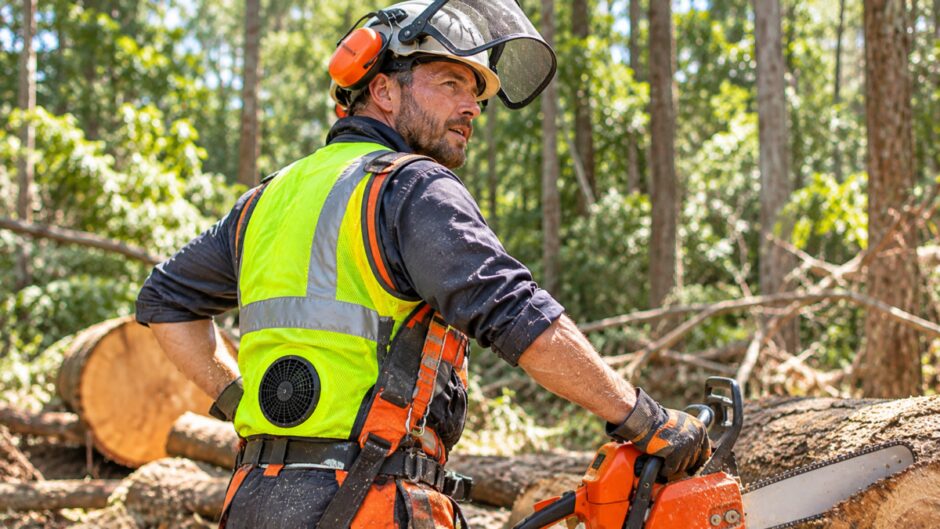

Forestry work piles required safety equipment on top of whatever the weather is doing: a helmet with a face screen, ear protection, cut-resistant chaps, and often a heavy brush jacket, none of it designed with heat in mind. That combination is what makes forestry heat exposure its own case, separate from working in short sleeves in an open field.
This guide covers what to check before adding a cooling vest to that setup, and five options available on Amazon right now.
Where Fan Cooling Vests Come From: A Japanese Invention
This entire product category has a specific origin, not a vague “ancient technique” story. In the 1990s, Hiroshi Ichigaya, a former Sony engineer, tried circulating water through a prototype garment to cool himself on a hot business trip; the tank kept leaking. He switched approaches: small fans that pull in outside air and speed up the evaporation of sweat. He patented the design and brought it to market in 2004 under the name kuchofuku (空調服), literally “air-conditioned clothing.”
The mechanism is the same one doing the work in every vest compared in this guide: fans near the waist draw in ambient air, and evaporating sweat does the cooling. It isn’t a refrigerant, and the vest itself isn’t lowering the air temperature.
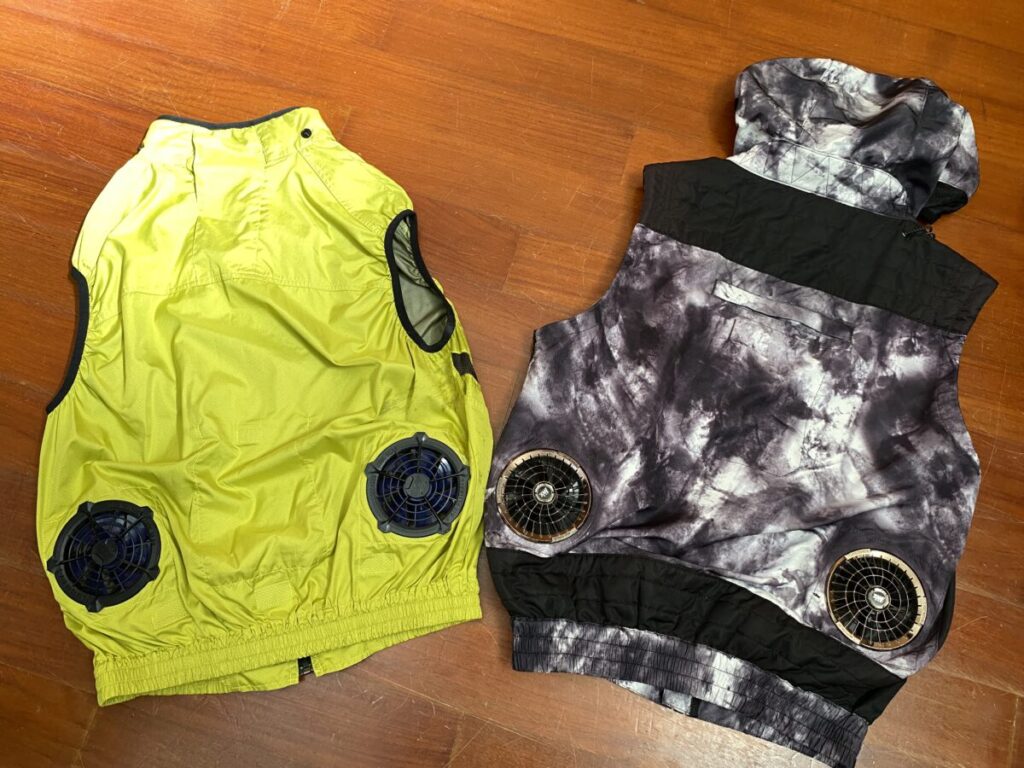
The category didn’t stay a niche product. A 2011 AFP report, amid a nationwide push to cut power use after the Fukushima disaster, put the number of Japanese companies issuing Kuchofuku’s gear to staff at nearly 1,000, including automakers, steelmakers, food manufacturers, and construction firms. It’s kept growing since: Japanese trade press (Sen-i News) estimated the domestic electric-fan-workwear market at roughly ¥20 billion in 2024, with newer entrants like Burtle now reported to hold close to half of shipment value, alongside the original Kuchofuku brand and Sun-S’s competing “kuchofuku-fujinfuku” line.
None of the vests compared below are official Kuchofuku products. They’re independent brands sold on Amazon, but they’re built on the same fan-and-evaporation design this Japanese invention started.
Sources: Government of Japan, “Cooling the Body with Fan-Equipped Clothes”; Web Japan, “Air-Conditioned Clothes”; AFP, “Air-conditioned clothes help Japan beat heat” (2011); Sen-i News market reporting (2024–2025).
What the Research Actually Says
There’s no dedicated heat-fatality count for forestry or logging the way OSHA tracks it for construction. Most safety data for this field is organized around the hazards that actually drive it, like falling trees and equipment, not heat specifically. What does exist is more indirect: OSHA’s Heat National Emphasis Program, renewed on April 10, 2026 through 2031, lists forestry and logging among its targeted high-risk outdoor industries, and the same patchwork of state rules covering agriculture (California, Colorado, Minnesota, and a handful of others) generally doesn’t name forestry specifically, leaving it to OSHA’s general duty clause in most states.
The best actual science on cooling vests worn with heavy protective gear doesn’t come from logging research. It comes from wildland firefighting, a related but distinct field. Peer-reviewed studies on firefighters found that a cooling vest worn under PPE measurably reduced skin temperature and physiological strain compared to PPE alone, and one study specifically found the benefit held up without adding metabolic burden: in other words, the vest didn’t make the work itself harder even with the extra weight. It’s firefighter-specific research, not logging-specific, but it’s the closest available evidence for what happens when you add a cooling layer under heavy, hot protective equipment rather than onto bare skin or light clothing.
5 Things to Check Before Buying
1. Will It Fit Under Chaps, a Brush Jacket, or a Helmet Harness?
This is the first filter, not an afterthought. A vest that works fine on its own can become useless once it’s compressed under cut-resistant chaps or a heavy brush jacket, the same way a harness or duty belt defeats a vest elsewhere in this series. Sleeveless, low-profile builds generally layer better under required PPE than a bulkier jacket-style vest.
2. Battery Life for Remote Sites With No Outlet
Logging and forestry work often happens somewhere a truck, not a building, is the nearest power source. The advertised runtime is almost always the lowest-speed figure, and real runtime at a working speed is typically a fraction of that. A 20,000mAh battery is a reasonable floor, and a charged spare matters more here than almost anywhere else in this series, simply because there’s nowhere nearby to recharge if you run out.
3. Canopy Shade Changes the Humidity Math
Working under tree canopy cuts direct sun exposure, which helps, but it can also trap humidity close to the ground, and evaporative cooling (which is how these fan vests actually work) loses effectiveness as humidity rises. A vest that performs well in an open, dry field won’t necessarily feel the same under dense, humid canopy. This isn’t a reason to skip one, just a reason not to expect open-field results in closed-canopy conditions.
4. Durability Against Brush, Bark, and Debris
Forestry work is harder on fabric than most of the jobs in this series: branches, bark, and brush catch on clothing in a way a construction site or a field mostly doesn’t. Check the fabric type and any reinforcement the listing mentions, and treat a flimsy fabric claim with more skepticism here than you would for warehouse or office use.
5. Reading Past the Marketing Numbers
“-24°C cooling” is a lab measurement of the cooling plate itself under controlled conditions, not a promise about how the air will feel under a helmet and chaps on a July cutting block. Treat it as a loose signal, not a literal temperature drop.
Specs below come from each listing. Confirm current pricing and availability on the product page before buying.
5 Cooling Vests for Forestry & Logging Work (2026)
1. MIDIAN 30V Cooling Jacket — Best for Open-Canopy Sun Exposure
Good for: landing areas, clearcuts, and other open-sun work with less canopy cover
A long-sleeve jacket in 100% cotton rated to block over 98% of UV rays, with an open-back “3D wind duct” design and a 20,000mAh battery across five speeds, rated up to roughly 10 hours at a moderate setting. The long sleeves add scrape and sun protection on the parts of a site that aren’t shaded by canopy.
2. Lvkakmox 21V Cooling Fan Vest — Best Under Chaps or a Brush Jacket
Good for: layering under required cut-resistant or brush PPE
A sleeveless vest with two fans rated up to 12,000 RPM and a 20,000mAh battery stretching to roughly 16 hours on its lowest of four speeds. Sleeveless and low-profile, it’s the one in this lineup most likely to actually fit under chainsaw chaps or a heavy brush jacket without being compressed shut.
3. LABEWVI 30V Cooling Vest — Best Fast Charging Back at the Truck
Good for: crews that can top off a battery from a truck inverter or power bank between sites
Five speed settings from roughly 7,100 RPM down to 4,100 RPM, with a 20,000mAh battery and Type-C fast charging, useful if a truck-based power source is the realistic recharge point for a remote site.
4. LABEWVI Semiconductor Peltier Vest — Best for Ear Protection & Dusty Cuts
Good for: avoiding fan intake clogged with sawdust, and not adding fan noise under ear protection
No fans at all: two Peltier (thermoelectric) modules cool the vest directly, with three modes the manufacturer rates down to -24°C, -20°C, and -16°C relative to skin temperature (see the note above on reading these numbers). Runtime drops to around 3 hours on the coldest setting, but no fan intake pulling in sawdust and no added fan noise under hearing protection are both genuine advantages on an active cutting site.
5. Foiueyga 4-Fan Cooling Vest — Best Budget Pick for a Crew
Good for: outfitting a ground crew without a large per-person cost
A short-sleeve, 4-fan vest on a smaller 10,000mAh battery at 7.4V, noticeably less powerful than the others, with up to roughly 6 hours of runtime on the highest setting. It’s the lowest-priced option here, a reasonable starting point for a crew before committing to more expensive gear per person.
| Model | Type | Speeds | Battery | Fabric | Best For |
|---|---|---|---|---|---|
| MIDIAN 30V Jacket | Fan | 5 (30V–9V) | 20,000mAh | Cotton, UV-block | Open-canopy sun |
| Lvkakmox 21V Vest | Fan | 4 (21V–15V) | 20,000mAh | Nylon | Under chaps / PPE |
| LABEWVI 30V Vest | Fan | 5 (30V–15V) | 20,000mAh, Type-C | Polyester | Truck-based charging |
| LABEWVI Peltier Vest | Peltier | 3 (-24°C to -16°C) | 20,000mAh, Type-C | Polyester | Sawdust / ear protection |
| Foiueyga 4-Fan Vest | Fan | 4 (7.4V) | 10,000mAh | Nylon, water-resistant | Budget / crews |
Which One Should You Get?
- Working landings and clearcuts with real sun exposure → MIDIAN 30V Jacket
- Need it to fit under chaps or a brush jacket → Lvkakmox 21V Vest
- Charging from a truck between remote sites → LABEWVI 30V Vest
- Running a chainsaw with ear protection, want no added noise → LABEWVI Peltier Vest
- Outfitting a ground crew on a budget → Foiueyga 4-Fan Vest
If It’s Not Pulling Its Weight on a Cutting Site
Test the vest under your actual PPE before writing it off. Chaps or a brush jacket sealing the cuffs shut will stop air from moving through the garment no matter how it performs on its own. If you’re cutting under dense canopy, temper your expectations too: the shade helps, but the higher humidity that comes with heavy tree cover limits how much evaporative cooling can achieve regardless of fan speed. And check what’s underneath: a cotton base layer holds sweat against your skin instead of releasing it, which undercuts the entire mechanism these vests rely on.
FAQ
Is there real research on cooling vests worn with heavy protective gear?
Yes, though it comes from wildland firefighting rather than logging specifically. Peer-reviewed studies found cooling vests worn under PPE measurably reduced skin temperature and physiological strain compared to PPE alone, without adding meaningful metabolic burden. It’s the closest available evidence for a cooling layer under heavy, hot gear, even though the occupation differs from forestry work.
Does tree canopy make cooling vests less useful?
It changes the tradeoff rather than eliminating it. Canopy reduces direct sun, which helps, but can also trap humidity, which reduces how well evaporative cooling works. Expect somewhat less dramatic results under dense canopy than in an open, dry clearing.
Will a cooling vest fit under chainsaw chaps?
It depends on the vest: bulk at the fan housings is the main constraint, the same issue that comes up with any harness, duty belt, or heavy jacket worn over a vest elsewhere in this series. Sleeveless, lower-profile vests generally layer better than a full jacket.
What should I wear underneath?
A moisture-wicking layer rather than cotton, since the cooling effect relies on sweat evaporating rather than being trapped against your skin.
Bottom Line
A cooling vest helps with the heat layered on top of required PPE on a hot cutting site, not with the equipment and falling-tree hazards that actually define forestry work’s real risk profile. The best evidence for what it can do comes from adjacent research on wildland firefighters, not logging itself. Fit under your actual gear and battery life for a remote site matter more here than the biggest number on the listing.
Specs above are manufacturer-stated figures as of publication. Check each product page for current pricing, specifications, and availability before buying.
More Heat Safety Guides
This site covers cooling vests for a range of outdoor jobs, each with its own buying considerations:
- Cooling Vests for the Job Site (Construction)
- Fan Cooling Vest for Fishing (Fishermen & Anglers)
- Cooling Vests for Farm & Landscaping Work
- Cooling Vests for Traffic Control & Security
- Cooling Vests for Delivery Drivers & Motorcycle Couriers
- Cooling Vests for Sanitation & Outdoor Cleaning Crews