Panda Works Club
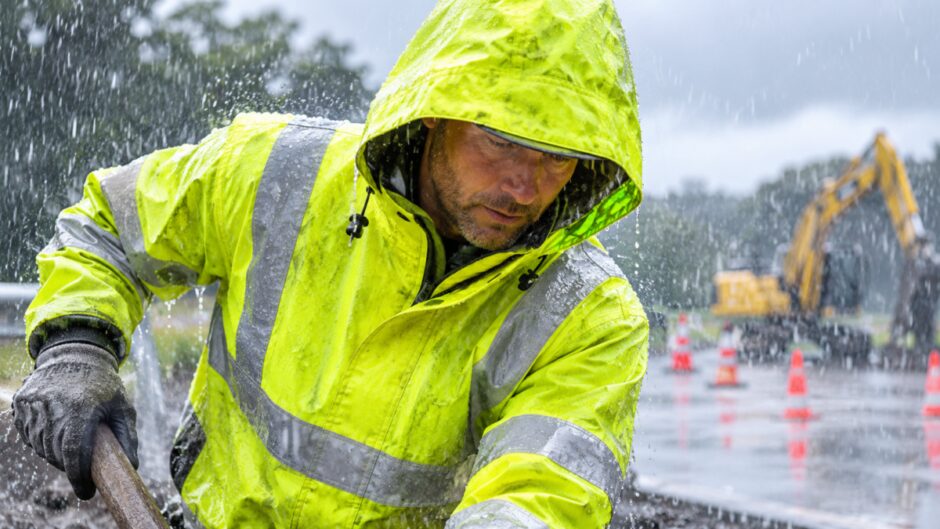

“April showers” isn’t just a saying: spring is when outdoor work crews that slowed down over winter ramp back up, right as rain becomes the main weather obstacle across much of the US. Construction, traffic control, landscaping, and delivery work don’t stop for rain the way they might for extreme cold or heat, which makes the right rain gear a year-round-relevant purchase that gets tested hardest in spring.
This guide covers why rain changes the risk picture for outdoor work, not just the comfort picture, what to check before buying a rain jacket for it, and five options available on Amazon right now.
This is a spec-based roundup: none of the jackets below has been used by the author. Check each live listing for current specs, sizing, and certification documentation before buying.
Why Rain Changes the Risk, Not Just the Comfort
For anyone working near vehicle traffic, rain is a documented driver-risk multiplier, not just a worker-comfort problem. NHTSA/FHWA data shows roughly 75% of weather-related crashes happen on wet pavement and about 47% occur during rainfall itself, with poor visibility conditions carrying a 30% greater chance that a crash results in injury compared to clear conditions. None of that is a statistic about workers specifically. It’s about how much worse drivers get at seeing and reacting in the rain, which is precisely why standing near that traffic in dark, non-reflective rain gear is a different risk than standing there when it’s dry.
That’s the reasoning behind a specific requirement in the Manual on Uniform Traffic Control Devices (MUTCD): workers in or near roadways are expected to wear ANSI/ISEA 107-compliant high-visibility apparel, and in reduced-visibility conditions like rain, that means “Type R” gear, rated for exactly this situation, as opposed to garments that are hi-vis colored but not built or tested for low-visibility weather. A black or navy rain jacket, however waterproof, doesn’t meet that bar.
Separately, OSHA’s cold stress guidance notes that cold stress isn’t limited to freezing temperatures: wind and rain can create real cold-stress risk even in the 50°F range, a detail that matters most in exactly the shoulder-season weather spring delivers.
What to Check Before Buying
1. ANSI/ISEA 107 Class and Type
Class 2 and Class 3 refer to how much reflective material and background color coverage a garment has. Class 3 is the higher bar, generally expected for higher-speed-roadway or lower-visibility work. “Type R” specifically means the garment is rated for exactly the reduced-visibility conditions rain creates, which is the detail to check if the work involves standing near traffic.
2. Waterproof Rating, Not Just “Water-Resistant”
“Water-resistant” and “waterproof” aren’t interchangeable claims. Taped seams are the detail that actually keeps water from getting in through the stitching: a jacket can be made of waterproof fabric and still leak at every seam without that detail.
3. Breathability and Mesh Lining
PVC and PU-coated shells block rain effectively but trap body heat and sweat just as effectively, which becomes its own problem on a warm, humid spring day. A mesh liner is the main design answer to that tradeoff, worth prioritizing for all-day wear over short-burst use.
4. Layering Room for Cold, Wet, Windy Days
Spring rain often comes with wind and temperatures in the range where OSHA’s cold stress guidance actually applies, not just summer downpours. A jacket cut tight enough to block layering underneath trades one problem for another on a cold, wet day.
5. Cuffs, Hood, and Hem — Where Water Actually Gets In
Most “this jacket leaks” complaints trace back to the openings, not the fabric: loose cuffs, a hood without a cinch, or a hem that rides up when reaching overhead. Adjustable hook-and-loop cuffs and a storm flap over the main zipper are the specific features to look for.
5 Hi-Vis Rain Jackets for Outdoor Workers
Specs below are as listed by sellers, and none was tested by the author. Check each live listing for current ANSI/ISEA certification documentation, sizing, and availability.
1. JORESTECH Hi-Visibility Waterproof Rain Jacket — Best Known-Quantity Option
Good for: roadway, construction, and high-traffic work where certification documentation matters
An ANSI/ISEA 107-2015 Class 3 Type R jacket with a lightweight PU-coated shell, taped seams, mesh lining, concealed hood, and a storm flap over the main zipper, a well-documented listing with the certification details spelled out.
2. SaphiRose Rain Suit — Best for Farm, Fishing, and Multi-Use Work
Good for: farm work, fishing, and motorcycle/delivery use where a single suit covers several jobs
A high-visibility reflective rain suit (jacket and pants) with a fine mesh liner, adjustable hood with a visor, a waterproof zippered pocket for a phone, and elasticized cuffs. Marketed across farm, fishing, and motorcycle use rather than roadway-specific work, so check the listing for ANSI documentation if that certification matters for your use case.
3. vitagear Hi Vis Class 3 Safety Rain Jacket — Best for Breathability Claims
Good for: all-day wear where overheating under the shell is the main complaint
An ANSI Class 3 jacket marketed specifically around airflow and moisture management: the listing describes a “microclimate regulation” design, which is worth weighing against the other options here if warm, humid rain is the more common condition where you work.
4. NORTHSKY Hi-Vis Reflective Rain Suit — Best for Mixed Outdoor Work
Good for: crews that move between road maintenance, construction, and other outdoor conditions in the same week
A waterproof hi-vis rain suit explicitly marketed across fishing, road maintenance, and construction use, made of a polyester/polyurethane shell with reflective strips and water-resistant pocket closures.
5. KwikSafety TORRENT TRENCH — Best Coverage for Roadway and Traffic Control
Good for: traffic control, surveying, and roadway work where leg and lower-body coverage matters
An ANSI/ISEA Class 3 trench-coat-length design in 100% PVC, built longer than a standard jacket for added lower-body coverage, marketed specifically for highway work, surveying, and roadside use. The tradeoff for that coverage is less breathability than a mesh-lined jacket.
| Jacket | ANSI Class | Style | Best For |
|---|---|---|---|
| JORESTECH | Class 3 Type R | Jacket, mesh-lined | Certification documentation |
| SaphiRose Rain Suit | Not roadway-specific | Jacket + pants suit | Farm, fishing, delivery |
| vitagear | Class 3 | Jacket | Breathability |
| NORTHSKY | Class 3 | Jacket + pants suit | Mixed outdoor work |
| KwikSafety TORRENT | Class 3 | Trench coat | Roadway, traffic control |
How to Pick
- Working near vehicle traffic → JORESTECH or KwikSafety TORRENT (Class 3, roadway-documented)
- Farm, fishing, or delivery work rather than roadway work → SaphiRose Rain Suit
- Warm, humid rain is the normal condition where you work → vitagear
- Moving between several types of outdoor work → NORTHSKY
FAQ
Is a hi-vis rain jacket legally required?
It depends on the work. For roadway and construction work near vehicle traffic, ANSI/ISEA 107 Class 2 or 3 compliance is generally expected, with Type R specifically called for in reduced-visibility conditions like rain. For farm, delivery, or general outdoor work away from traffic, there’s no equivalent blanket requirement; it becomes a personal or employer choice.
What’s the difference between Class 2 and Class 3?
Class 3 requires more background material and reflective tape than Class 2, and is generally expected for higher-speed-roadway or lower-visibility work. Check the specific jacket’s documentation rather than assuming: “hi-vis colored” and “ANSI-certified” aren’t the same claim.
Does a waterproof jacket make me colder in cool, windy rain?
It shouldn’t, if it has enough room to layer underneath. A tight-cut waterproof shell with nothing underneath can actually leave you colder than a looser one over a warm base layer. OSHA’s cold stress guidance applies even around 50°F when wind and rain are both present.
Will my employer pay for rain gear?
OSHA generally requires employers to cover PPE costs, but ordinary rain gear is a specific exception to that rule, so don’t assume it’s provided without checking your employer’s actual policy.
Can I wash a hi-vis rain jacket without damaging the reflective tape?
Check the specific product’s care instructions. Reflective tape and PU or PVC coatings can degrade with harsh detergents, high heat, or machine drying. Most manufacturers recommend cold water and air drying.
Specs above are manufacturer-stated figures as of publication. Check each product page for current pricing, specifications, and availability before buying.
More Heat & Safety Guides
This site covers gear for a range of outdoor jobs, each with its own buying considerations:
- Cooling Vests for Traffic Control & Security
- Cooling Vests for the Job Site (Construction)
- Cooling Vests for Farm & Landscaping Work
- Cooling Vests for Delivery Drivers & Motorcycle Couriers
- Cooling Vests for Sanitation & Outdoor Cleaning Crews
- Cooling Vests for Forestry & Logging Work
- Fan Cooling Vest for Fishing (Fishermen & Anglers)
- Dust & Pollen Masks for Landscaping and Lawn Care Work